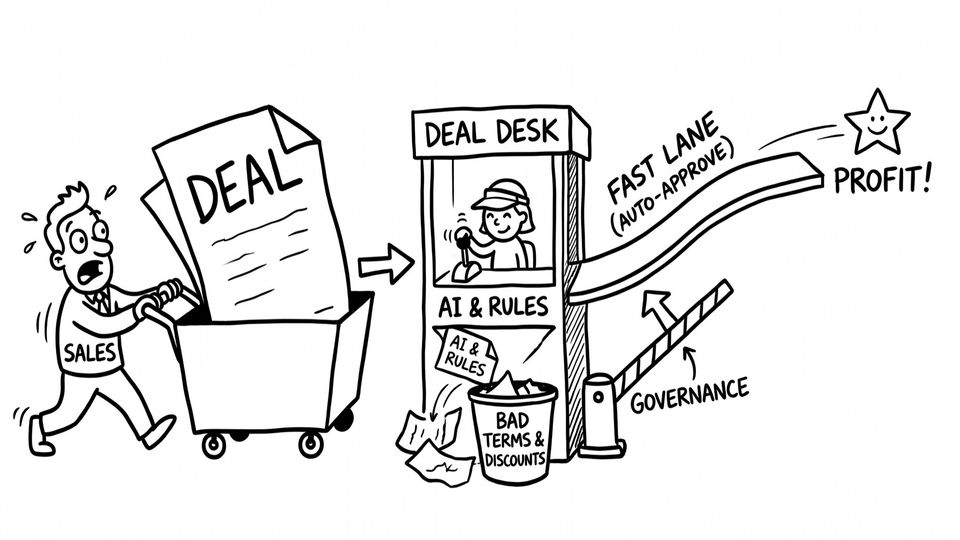
AI Deal Desk: Protect Margin Without Slowing Sales
Whitepaper

Jeroen De Koninck
10 min read
How commercial governance, deterministic unit economics, and constrained AI keep enterprise deals profitable without stalling momentum.
Effective deal governance starts with commercial design, not AI. Before automating deal reviews, revenue leaders need clear approval thresholds, consistent financial calculations, standardized risk categories, and defined paths for restructuring deals.
Executive Summary
This whitepaper explores how revenue organizations can protect deal profitability without creating unnecessary approval bottlenecks. It combines a commercial governance framework with an AI-powered deal-review application, evaluated across 20 synthetic deal scenarios and three system configurations.
The guardrailed configuration correctly calculated deal margins, assigned approval routes and identified all expected contractual and policy risks in all 20 synthetic test scenarios, achieving a 100% scenario pass rate. It also reduced median execution time by 35.7% and median API cost per deal by 50% compared with the baseline. Adding a second AI reviewer increased cost and execution time without improving the overall pass rate.
Four key takeaways
- Establish governance before automation: Define commercial policies, approval thresholds and deterministic financial controls before introducing AI.
- Give AI the right responsibilities: Use AI to interpret unstructured contract and policy information, identify risks and synthesise recommendations, not to perform financial calculations or make final approval decisions.
- More AI does not automatically mean better results: In this evaluation, the constrained single-agent configuration achieved the same scenario-level pass rate as the two-stage reviewer, with lower execution time and API cost.
- Keep humans accountable: AI can support commercial decision-making, but human oversight remains essential for exceptions, complex negotiations and legal decisions.
Why poorly governed enterprise deals quietly destroy margin
Enterprise B2B SaaS companies in the $25M to $150M ARR band rarely lose gross margin through a single reckless discount. Margin erosion can become more pronounced as quarter-end approaches, when pressure to hit sales targets increases and commercial concessions accumulate.1,2
Consider a familiar quarter-end scenario. An Account Executive submits a deal carrying a moderate discount, assuming it qualifies for routine VP-Sales sign-off. On the surface, the headline discount looks manageable. Beneath the surface, the rep has paired that discount with Net 90 payment terms and a generous block of unbilled onboarding hours.
When hosting and support costs (calculated on undiscounted list price), unbilled implementation labor at $150 per hour, and a 3.0% working-capital drag for Net 90 terms are tallied together, the deal’s effective gross margin drops to 59.78%. That puts the deal materially below the illustrative 72.0% minimum margin threshold used in this governance model. The threshold is a model assumption for demonstrating approval logic, not an industry-wide SaaS benchmark.
The discount bands and margin thresholds are illustrative policy assumptions. In a production environment, they should be calibrated to the company's product margins, cost structure, growth strategy and commercial objectives.
Revenue organizations often respond to this risk by swinging between two bad extremes:
- Weak governance: Approvals rely on email threads and static spreadsheets, allowing stacked concessions and risky customer contract redlines (such as Most Favored Customer pricing clauses or uncapped liability) to slip through unnoticed.
- Approval bottlenecks: Every non-standard quote gets routed into a manual deal-desk queue, stalling commercial momentum and training sales reps to treat Finance and Legal as adversaries.
A high-performing deal desk solves both problems at once. Its job is not to tell salespeople “no”. Its job is to tell them how to restructure the deal so it closes profitably.
Design deal-desk governance before you automate
Before writing a line of AI code, you have to design the commercial operating model. Automation cannot fix ambiguous decision rights.
A durable deal-desk governance framework rests on four clear operating lanes:
- Auto-Approve: Standard deals clear immediately with no human review.
- VP-Sales Authority: Moderate concessions stay with sales leadership, close to the customer.
- CFO and Legal Escalation: Deep discounts, sub-floor margins, stretched terms, or high-risk redlines route to Finance and Legal.
- Restructure Over Reject: Escalated quotes return with concrete levers to recover margin (tighter payment terms, paid onboarding scope, or capped liability).
Because enterprise deals frequently stack multiple concessions, approval rules must run in a strict order of precedence. CFO and Legal escalation triggers always override commercial discount bands, and any quote falling outside explicit auto-approve or VP-Sales criteria defaults to Finance review:
Table 1: Approval-lane precedence across discount, gross margin, payment terms, and contract redlines
| Order | Lane | Discount | Gross margin | Payment terms | Contract redlines | Rule |
|---|---|---|---|---|---|---|
| 1st | CFO and Legal | Above 25.0% | Below 72.0% floor | Net 90 | High-risk clause (MFC, uncapped liability, 30-day termination for convenience, non-standard audit) | Any single trigger escalates |
| 2nd | Auto-Approve | Up to 15.0% | 75.0% or higher | Net 30 | Standard only | All four conditions must hold |
| 3rd | VP-Sales | Between 15.0% and 25.0% | 72.0% or higher | Net 30 or Net 60 | Standard only | All four conditions must hold |
| Last | Finance Review | Residual | Residual | Residual | Residual | Everything left after lanes 1–3 |
For this governance model to stick inside a company’s revenue operating system, ownership has to be explicit. Finance and Revenue Operations own the pricing calculations, margin floors, and approval thresholds. Legal and Deal Desk maintain the standardized risk taxonomy and pre-approved contract fallbacks. Every exception approved by leadership feeds back into quarterly pricing and packaging reviews so recurring friction points become standardized policy.
Build an AI-powered deal desk with hard rules and soft judgment
To test how this operating model performs in practice, I built an automated deal-desk agent that pairs deterministic financial rules with an AI contract and policy reviewer.
In its current form, the application demonstrates the end-to-end decision workflow using structured deal payloads, a local SQLite database, and an interactive evaluation dashboard, rather than live Salesforce or HubSpot integrations. In a production deployment, those structured inputs would map directly to CRM quote objects and approval queues.
Details
- Discount
- Payment
- Service hours
- Contract redlines
- Account identity
Details
- Margin
- Approval lane
- Working-capital penalties
- Python/SQLite rules
3.1 Baseline
V1 Baseline Agent
Config 1 — Starting Agent
Details
- BM25 keyword search
- Unconstrained tool schemas
- Prompt caching
- Evaluator-Optimizer
Pass rate: 85.0% Cost: Highest Latency: Highest
3.2 Guardrailed
V2 Guardrailed Agent
Config 2 — Guardrails + Caching
Details
- BM25 keyword + dense RRF
(↑ pass rate)
- Must use exact risk flags
(↑ pass rate) - Constrained tool inputs
(↑ pass rate) - Stricter memo schema & prompt
(↓ latency)
- Prompt caching
(↓ cost, ↓ latency)
Pass rate: 100.0% Cost: Lowest Latency: Lowest
3.3 Evaluator-Optimizer
V3 Evaluator-Optimizer Agent
Config 3 — Model critic review
Details
- Critic reviews every memo
(↑ cost, ↑ latency) - Conditional producer revision
(extra turn only when needed)
- Revised 1/20 deals
(no pass-rate lift, weaker ROI)
Pass rate: 100.0% Cost: Higher Latency: Higher
Details
- Lane
- Margin
- Risk flags
- Memo
Pass Rate: Percentage of test scenarios in which the system correctly calculated deal economics, assigned the required approval route and identified all expected contractual and policy risks. All three criteria must be met for a scenario to pass.
Figure 1: End-to-end deal-desk flow starting with deterministic calculations, followed by retrieval and agents, to human-ready output. (opens figure source image in a new tab)
Table 2: End-to-end deal-desk workflow stages, from structured intake through human sign-off
| Workflow Stage | Processing Mechanism | Inputs & Actions | Output Passed Forward |
|---|---|---|---|
| 1. Deal Intake | Structured Payload (from CRM)* |
Captures ACV, contract term, discount, payment terms, onboarding hours, and customer redline text | Normalized deal record |
| 2. Margin & Routing Engine | Deterministic Rules (Table 1) |
Computes list ARR, COGS stack, working-capital drag, gross margin, and approval tier | Exact margin waterfall and base routing tier |
| 3. Deal Reviewal Agent | Constrained AI + Policy Search | Reads free-text redlines, matches internal policy playbooks, and pulls illustrative win-rate and sales-cycle context from a seeded dataset of 250 synthetic historical deal records | Standardized risk flags and policy citations |
| 4. Executive Decision Gate | Structured Memo + Human Review | Generates an executive summary with quantified margin-recovery fallbacks | Routed to VP-Sales, CFO, or Legal for final sign-off |
* The demonstration uses structured deal payloads rather than a live CRM connection. In production, these fields would map to CRM quote objects and approval queues.
The architecture enforces a strict division of labor:
- Hard rules calculate the economics: Deterministic formulas compute list ARR, hosting and support costs, services costs, working-capital drag, gross margin, and required approval tiers. The AI never guesses at spreadsheet calculations.
- AI reads the unstructured fine print: Rigid rules cannot interpret free-text customer redlines. The AI reads proposed contract edits, searches internal deal-desk policies and contract playbooks, classifies legal exposure into standardized risk codes, and retrieves illustrative win-rate and sales-cycle context from a seeded dataset of 250 synthetic historical deal records.
- Humans own final exceptions: The system outputs a structured decision memo with quantified negotiation alternatives, while VP-Sales, CFO, and Legal retain final sign-off authority.
Benchmark three AI deal-review architectures
A common assumption in enterprise AI is that complex commercial decisions require “multi-agent” architectures, where one AI drafts a recommendation and a second AI audits the work before a human sees it.3,4
Yet empirical studies increasingly show that without deterministic external checks, second-pass AI critique rarely outperforms a well-constrained single agent and can introduce new failure modes.5,6
To test whether layered AI oversight improves governance of contractual and commercial risk in deal desks, I evaluated 20 adversarial deal scenarios across three system configurations (60 total runs).7
The test suite included standard quotes, hidden margin traps (where headline discounts stayed at or below 20% yet breached the 72.0% floor), high-risk legal redlines, and compound traps combining both.
- [Version 1] Baseline AI agent: A single AI assistant equipped with basic tool definitions and simple keyword policy search.
- [Version 2] Guardrailed AI agent: The same underlying model upgraded with strict risk-category menus, explicit verification sequences, hybrid policy retrieval, and static policy-context reuse.
- [Version 3] Evaluator-Optimizer AI agent: Version 2 plus an automated second-pass AI auditor reviewing every draft memo against the raw deal data before release.
The full technical configurations and benchmark results are available in the evaluation dashboard (opens in a new tab). Summarized configuration versions and benchmarks below:
Table 3: Step-by-step workflow differences across the three tested agentic AI configurations
| Version | Configuration | Step 1: Financial & Tier Check | Step 2: Policy & Clause Lookup | Step 3: Risk Classification | Step 4: Review & Release |
|---|---|---|---|---|---|
| V1 | Baseline AI agent | Deterministic tool (unconstrained sequence) | Basic keyword search | Free-text / unvalidated risk labels | Released immediately after single pass |
| V2 | Guardrailed AI agent | Deterministic tool (mandatory first step) | Hybrid policy + clause retrieval with reused policy context | Strict menu of standardized risk codes ("Flags") | Released immediately after single pass |
| V3 | Evaluator-Optimizer AI agent | Deterministic tool (mandatory first step) | Hybrid policy + clause retrieval with reused policy context | Strict menu of standardized risk codes ("Flags") | Audited by a second AI reviewer; triggers a rewrite pass if flagged |
Table 4: Core benchmark results across 20 scenarios per version (60 total runs in the eval harness)
| Core Benchmark Metric | V1: Baseline AI agent | V2: Guardrailed AI agent (Recommended) | V3: Evaluator-Optimizer AI agent |
|---|---|---|---|
| Scenario-Level Pass Rate | 85.0% (17/20) | 100.0% (20/20) | 100.0% (20/20) |
| Risk Classification F1 Score (0 to 1) | 0.757 | 1.000 | 0.983 |
| Median Agent Execution Time (p50) | 73.1s | 47.0s (-35.7%) | 51.4s (+9.3% vs. V2) |
| Median Token/LLM API Spend per Deal | $0.1029 | $0.0514 (-50.0%) | $0.0640 (+24.5% vs. V2) |
Technical recommendations for quality, speed and cost
Three findings stand out for commercial and technology leaders:
1. Keep financial calculations out of the model
First, separating financial calculations from AI-generated analysis kept margin calculations and approval-tier routing correct across all 60 benchmark runs. The observed failures were concentrated in the classification of unstructured contract and policy risks.
2. Guardrails cut failures, latency, and API spend
Second, tightening the operating environment to a guardrailed AI agent eliminated the classification failures observed in the baseline configuration while cutting execution time and cost.
Version 2 combined stricter output constraints, explicit verification steps, and improved policy retrieval. The resulting configuration lifted the scenario-level pass rate from 85.0% to 100.0% (with risk-flag precision and recall both reaching 1.000), reduced median agent execution time by 35.7% (from 73.1s to 47.0s), and halved median API cost (from $0.1029 to $0.0514 per deal).*
* These figures measure automated agent execution time and API spend (input tokens, output tokens, and cache), not end-to-end deal-desk turnaround once human review queues are included.
Measured: deterministic pass rate vs median API cost per deal.
Bubble size represents median processing time.
Measured: mean precision (correctness of raised flags) and recall (coverage of required flags) by version.
Figure 2: Quality versus cost and risk-flag precision/recall across Versions 1–3, illustrating how Version 2 closed the baseline's taxonomy gaps without a second reviewer. (opens figure source image in a new tab)
3. A second AI reviewer added cost without raising pass rates
Third, adding a second AI reviewer introduced cost and precision trade-offs without lifting pass rates.
In our evaluation harness, scenario-level pass rate requires exact margin calculations, exact approval routing, and 100% recall of expected risk flags (zero missed risks).
Mandatory risk recall is scored against exact standardized risk codes, not the narrative memo. A risk described accurately in prose under an unrecognized label still counts as a missed flag. Emitting false alarms on a deal with zero expected risks also fails the clean-deal check.
Precision measures how many flagged risks were valid. Recall measures how many required risks were identified. F1 combines the two into a single classification score.
The second-stage auditor intervened on just 1 of the 20 deals (a scenario involving a Most Favored Customer clause with embedded audit language) where version 2 had already identified the primary risk. By appending an extra audit tag, the second reviewer preserved 100% recall on the required flag (keeping the scenario-level pass rate), but lowered strict tag precision to 0.975, pushed that single deal’s processing time to 163.5 seconds, and raised median API cost by 24.5% across the suite.
While an additional alert may be useful to Legal in ambiguous cases, this implementation increased cost and latency without improving scenario-level pass rates.
Measured: median API cost and median end-to-end agent latency by version.
Figure 3: Median API cost and agent latency across Versions 1–3, highlighting Version 2’s lower unit cost and faster processing. (opens figure source image in a new tab)
Why polished AI memos can still fail operational controls
The most important governance lesson from the benchmark did not show up in the headline pass rates. It appeared when an independent senior AI model graded the written quality of every deal memo on a 1-to-5 scale against a rubric covering commercial accuracy, policy grounding, executive clarity, and actionability.
The Baseline Agent’s (configuration 1) memo earned an average score of 4.99 out of 5.00, matching configuration 3 (4.99) and edging out version 2 (4.97). Yet configuration 1 failed 15% of the benchmark.
Put simply: the commercial story looks safe while the control system acts on the wrong signal, so risky deals can slip through, or clean deals get escalated.
The disconnect comes down to the difference between writing for humans and feeding structured data into software. Configuration 1 failed on three deals for two straightforward reasons:
Inventing custom labels instead of using system codes (2 deals): On a contract with a 30-day termination-for-convenience clause and another combining Net-60 terms with non-standard audit rights, the AI spotted the risks, cited the right policies, and explained them clearly in prose, earning a 5.00 writing score. However, instead of choosing from the fixed menu of standardized risk codes, it wrote its own free-form labels. Because automated approval software relies on exact codes rather than paragraphs of text, the system treated those risks as missed.
Triggering false alarms on a clean quote (1 deal): On a routine VP-Sales deal with a 75.37% gross margin and zero policy violations, the AI treated harmless background notes as blocking risks, stalling a quote that should have moved forward.
For CROs and CTOs, this is a critical warning. Convincing executive prose masks operational failure. If an AI writes a persuasive memo for a human reader but outputs inconsistent tags for your CRM, approval routing, automated alerts, and executive reporting break down. Enterprise AI must be evaluated on machine-valid schema compliance, not just how well it writes.
What revenue and commercial leaders should do next
Deploying AI in commercial operations does not always require rebuilding your sales organization around experimental multi-agent workflows. Four practical lessons stand out for commercial leaders:
Codify commercial policy before introducing AI. Define your margin floors, discount bands, working-capital penalties, and escalation triggers in deterministic rules first, reserving AI for unstructured judgment rather than core financial calculations.
Enforce your operating taxonomy on AI outputs. Constrain AI classifications to a fixed menu of business risk codes so recommendations plug cleanly into CRM workflows and approval queues.
Fix the primary AI workflow before adding layers of oversight. Better policy retrieval, clear instructions, and constrained inputs solved the baseline’s classification errors without the cost and latency tax of a second AI reviewer.
Equip sellers to restructure, not just escalate. Configure deal-desk outputs around specific commercial trade-offs (payment terms, onboarding scope, liability caps) so reps can protect margin while maintaining commercial momentum.
Where this evidence stops
Leaders should interpret these results with clear boundaries in mind. The benchmark evaluated 20 synthetic deal scenarios (including small edge-case cohorts of two to five deals) against a seeded historical dataset using a single AI model family. It demonstrates technical reliability and architectural trade-offs in a controlled workflow, not measured margin lift in a live production sales organization.
Truly bespoke, multi-document enterprise negotiations will still warrant direct legal counsel alongside automated triage.
Measured: deterministic pass rate by difficulty band. Small bands show exact counts (k/n).
Figure 4: Pass rates by difficulty cohort, showing where Version 1 struggled and Version 2 cleared every band. (opens figure source image in a new tab)
Explore the application and evaluation dashboard
GitHub repository (opens in a new tab) Evaluation dashboard (opens in a new tab)
References
- Larkin, I. (2014). The Cost of High-Powered Incentives: Employee Gaming in Enterprise Software Sales. Journal of Labor Economics, 32(2), 199–227. doi.org/10.1086/673371 (opens in a new tab).
- Marn, M. V., Roegner, E. V., & Zawada, C. C. (2003). The Price Advantage. McKinsey & Company. mckinsey.com — The power of pricing (opens in a new tab).
- Madaan, A., Tandon, N., Gupta, P., et al. (2023). Self-Refine: Iterative Refinement with Self-Feedback. arXiv. doi.org/10.48550/arxiv.2303.17651 (opens in a new tab).
- Wu, Q., Bansal, G., Zhang, J., et al. (2023). AutoGen: Enabling Next-Gen LLM Applications via Multi-Agent Conversation. arXiv. doi.org/10.48550/arxiv.2308.08155 (opens in a new tab).
- Cemri, M., Pan, M. Z., Yang, S., et al. (2025). Why Do Multi-Agent LLM Systems Fail? arXiv. doi.org/10.48550/arxiv.2503.13657 (opens in a new tab).
- Huang, J., Chen, X., Mishra, S., et al. (2023). Large Language Models Cannot Self-Correct Reasoning Yet. arXiv. doi.org/10.48550/arxiv.2310.01798 (opens in a new tab).
- Anthropic. (2026). Demystifying evals for AI agents. anthropic.com — Demystifying evals for AI agents (opens in a new tab)